14.1
SPEEDWAY WORLD CHAMPIONS - Supplements
14.1.1 - THE FIRST SPEEDWAY WORLD CHAMPIONS, ( - pre-1936.)
.
Before the first ACU-organised World Championship, held at
Wembley’s Empire Stadium in 1936 as “The Auto-Cycle Union
Official Speedway Championship of the World” , (it was 1954 before
the Wembley Finals came under FIM stewardship though its forerunner,
the FICM approved and recognised the ACU’s World title,) there were
a number of other championship meetings where the title of World
Champion, - Speedway, or its precursor, 'Dirt-Track' - , was raced
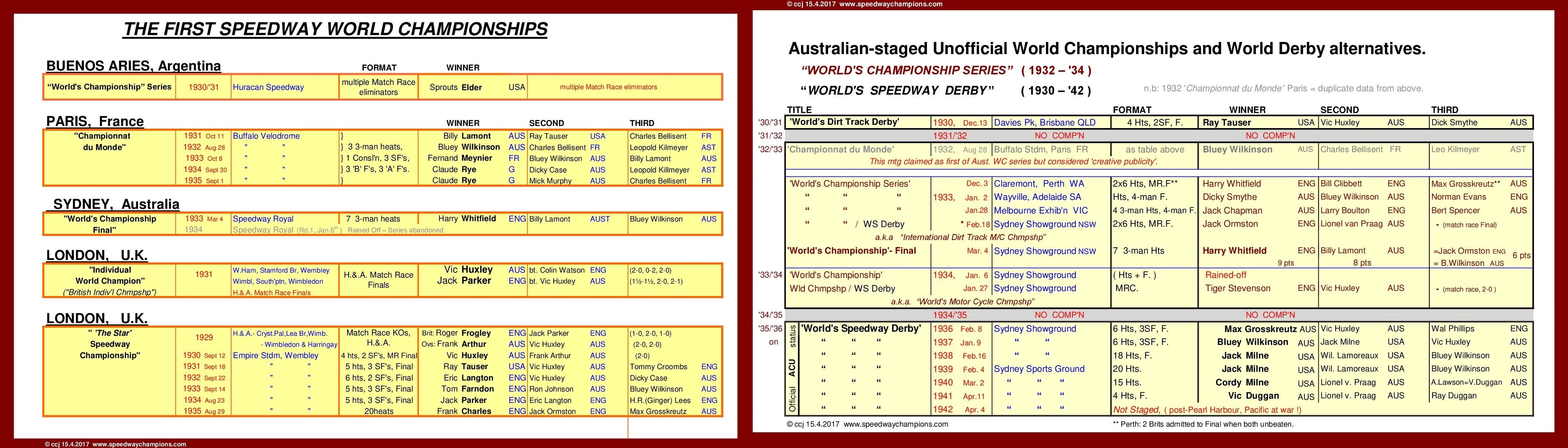
for; see table below.
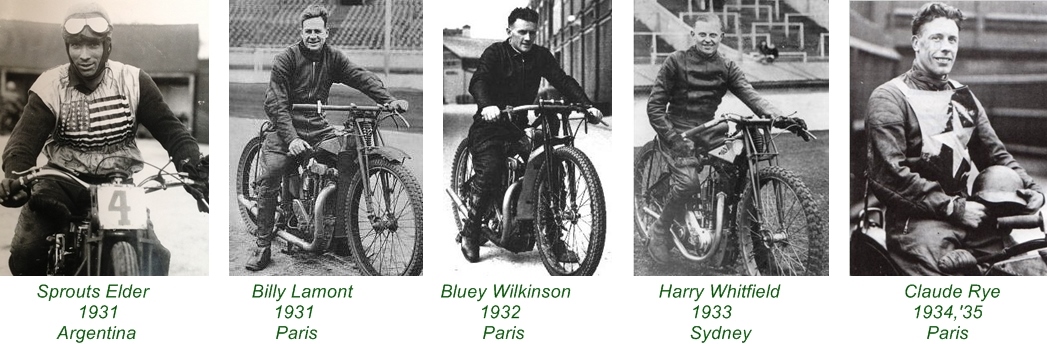
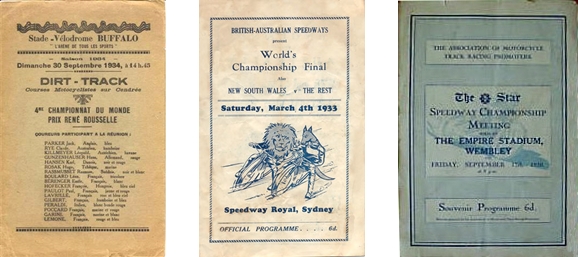
Paris 1934 Sydney 1933 Wembley 1930
With
riders migrating South from Europe’s winter not only to Australia
but also for a few years to a new venture in Argentina and Uruguay, a
"World's Championship Series" for the "Pour la
Noblesse" trophy sponsored by the National Tobacco Company was
set up in Buenos Aires by AJ Hunting for the 1930/'31
season. Visitors and local riders met each other 3 times in a
series of eliminating match races through the course of the
season at Huracan Speedway, Buenos Aires, concluding in February
1931, when American Sprouts Elder made it through to those final
stages and, following recent research, is today accepted as having
been the winner and thus the first ever World Champion. (An
article reviewing the contest can be read in Sppmt #1 below.
In France at the Buffalo Velodrome, Paris a single meeting for the
'Championnat du Monde' was held in October 1931 and was won by the
Australian Billy Lamont, ( shown below, with trophy, inscribed
'Championnat du Monde de Dirt track, 1931 Coupe Brampton'.) The
competition became an annual autumn event until the first
ACU/FICM Wembley World Final, each Paris staging being dominated
by top-name Dirt Track stars at the forefront of the British racing
scene and Englishman Claude Rye was a double winner.
 In Australia a “World’s Championship Final” was
held in March 1933 at Sydney’s Speedway Royal, the programme of
which informs of it having had 5 qualifying rounds in Paris, Perth,
Adelaide, Melbourne and Sydney, (though it is suspected that the link
to Paris was 'creative publicity'.) Billy Lamont and Bluey
Wilkinson, who featured regularly amongst the French prize winners,
were pipped for the title by the Englishman from Middlesbrough,
Wembley's Harry Whitfield, (seen below, receiving the trophy: Johnnie
Hoskins on left.)
In Australia a “World’s Championship Final” was
held in March 1933 at Sydney’s Speedway Royal, the programme of
which informs of it having had 5 qualifying rounds in Paris, Perth,
Adelaide, Melbourne and Sydney, (though it is suspected that the link
to Paris was 'creative publicity'.) Billy Lamont and Bluey
Wilkinson, who featured regularly amongst the French prize winners,
were pipped for the title by the Englishman from Middlesbrough,
Wembley's Harry Whitfield, (seen below, receiving the trophy: Johnnie
Hoskins on left.)
When the first meeting of the 1934 event in
Sydney was rained off the Series was re-structured and 'World's
Derby' competitions, - World Championships in all but name - , were
re-instated, with official ACU status. (The 1939 programme is shown, Rt., winner Jack Milne, his second consecutive win.) Details of the WC qualifier
meetings and of the Derby series are to be seen in the extended table
below., with background and full rider line-ups given in Sppmt #2 below.
.....................................................................................................................
Supplement #11931 World Championship, Buenos Aires, Argentina.
C. Jewes 25.6.2012, (update, p2, 23.8.2013 )
Putting together a Fixtures & Results list for the 2 seasons that AJ Hunting promoted in Buenos Aires and
Montevideo between 1929 and 1931, taken primarily from 'The Auto' magazine of the day, has highlighted
information on the World Championship Series that was run there in the second season.
Having run the Argentine Open Championship in the initial season, - won by Frank Varey - , the following year the
stakes were upped when AJH secured the sponsorship from Argentinian tobacco firm 'La Compañía Nacional de
Tabacos', (National Tobacco Co.) for a “super” championship along the same 2-man-race lines with a $5,000 prize
plus a handsome trophy.
The UK press results that winter for the Buenos Aires season didn't start appearing until December: the Christmas
report tells us the 'so called World's Championship' started early in the season. The scheme of this World's
Championship … . has every rider meet the others 3 times, …. and complained that when the big boys like Sprouts
Elder are up against a local Argentine rider it becomes a bugbear with just 2 riders per race unless there were engine
problems, etc. The event format on each of these Championship nights was a number of match races from which
riders became eliminated during the course of the season, (to the extent that an extra event had to be added to the
evenings' programme toward the end of the season when the number of riders involved reduced and only a few
Championship match races remained.) The limited reports mailed or available for the first half of the season, i.e. up
to the New Year, do identify the Championship as having been run on the Huracan programme on Dec.13th and 27th.
From January onward the event was programmed at least 4 times, - 10th, 17th, 31st and Feb. 11th, - it would appear
that no World Championship Series rounds were held at River Plate Speedway.
For the meeting of 31st Jan. there was excitement in “an elimination heat of the 'Pour de Noblesse'* World
Championship Series in which Sprouts Elder and Bob Harrison were matched, a rerun from the previous meeting.”
When Harrison again had engine failure on the first lap Sprouts continued “as if he had the world to beat,” ignoring
the red flag on 2 successive laps, and then the black flag on the last. Over the loudspeakers it was declared a no-race,
but Sprouts entered an objection on the grounds that there was no need to stop him in a championship race. In the end he
was rightly awarded the race. When seen that evening The Auto's reporter declared “this 'Pour la Noblesse'* trophy
is a lovely pot and carries a $5,000 cash prize with it. Sprouts has ear-marked it for himself and I rather fancy his
chances. He has not lost a single race in the series yet !”
At the meeting of Feb. 11th local rider Juan Pagano was awarded his round that evening because Frank Varey was
injured and unable to partake, and we are told he therefore would be meeting Sprouts Elder in the next round ! There
are no more known results after that last date, ( - just like today, 80+ years later, once the UK racing season start the
overseas news in the speedway press gets bottom priority and dries up,) but clearly the Championship event had still
to reach its climax and the World Champion declared, but we do know that Sprouts had not lost a single
Championship race and was still in it in February, - the previous years' national championship was concluded on
Feb.12th , Hunting was leaving for New York in the third week of February, and Sprouts' next and presumably final
race for the Championship was against a local 'newcomer !
A 1970's biographical tribute to Sprouts presently on the OTS website, ( Files/Sprouts Elder,) composed on the
occasion of a memorial race in his home town of Fresno and citing facts attributed to Mssrs Stenner, Clymer and
Lanning, informs us that “... he became the International Champion in 1931.” (See page extract, in Update below.)
Whether the word 'International' is a synonym for 'World' or comes from Hunting's company name, it does strongly
support the emerging conclusion from the foregoing, made with a high degree of certainty, that the 1931 World
Champion, - the first ever World Champion - , was America's Sprouts Elder.
C. Jewes,
Rutland, UK. 25.6.2012
www.speedwaychampions.yolasite.com
Ref, OTS: http://sports.groups.yahoo.com/group/oldtimespeedway/
* Footnote,
'Pour la Noblesse' – “For the Nobility” - , was a cigar brand of the National Tobacco Company, its successors
being part of today's BAC, - British American Tobacco, its major shareholder. The business was started in Argentina
in 1898, the company formed in 1913, and renamed Nobleza Piccardo in 1977 after its best selling line, when it had
a 63% share of the Argentinian cigar/cigarette market, (- it also produces snuff.) From 1923 it manufactured Players
cigarettes under license, along with an extensive range of other US and international brands which today include
Lucky Strike, Pall Mall and Camel Blue.
An approach has been made to Nobleza Piccardo in the faint hope that they may have archives that could reveal
more about the 1931 World Championship, but having asked around they have found nothing.
.........................................................................................................
23 Aug. 2013: UPDATE TO
“1931 World Championship, Buenos Aires, Argentina.”
Browsing OTS recently, a Long Beach, Ca. programme dated 25.7.1933 was spotted. It bears a list of
riders, No.4 being Sprouts Elder, (and thus according with the racing number borne in the photograph
below, taken from “Thrilling the Millions” by Tom Stenner,) and shown on the front of the programme is
a snap of the aforementioned Mr. Elder with the caption "Sprouts Elder, World's Champion".
This contemporaneous item verifies, I feel sure, the outcome of the 1931 competition in Argentina, -
that the winner was Sprouts Elder, and that as such he was the first ever World Champion.
..................................................................................................................... Supplement #2EARLY WORLD CHAMPIONSHIPS - AUSTRALIA
C. Jewes 1.3.2014
'World's Championship Series' 1932-'34
'World's Speedway Derby' 1930-'42
- For 'World Derby' read World Championship -
The World Champions' page of the Speedway Champions website covers such known unofficial championships
prior to the formalization of the title by the ACU (with FICM recognition) in 1936, including the 1933 Australian
World's Championship in Sydney. But for a good part of this decade, in parallel to, and with equal ACU authority
to the UK Wembley event, a less well-known equivalent championship series was staged in Australia, the
“World's Speedway Derby”. To understand its genus it is best to consider the two competitions alongside each
other. ( Full results, plus venues, dates, formats, etc. as well as Line-ups, are given at the end of this document. )
World's Championship Series.
For the 1932/'33 season the Sydney Showground promoters, (Hoskins, Parker, Arthur, Ormston, Beardsmore,)
organised their own World Championship Series (WCS) with a troupe of English tourists and returning Australian
stars. (The same squads also took part in the Aus. v. England Test Match series.) The WCS was initially to have
qualifying rounds at each state capital in which the top scorer from each of two sets of heats, for Aussie and for
English riders respectively, would meet in a match race final, and points were to be accumulated for the Final
meeting. An earlier World Championship staging in France at the Buffalo Stadium, Paris, which had been won by
Bluey Wilkinson, was said to have constituted one round, though this is thought to have been 'creative publicity'
to hype up the WCS and raise its status above that of the French 'Championnat du Monde'.
The premise for the Series got modified along the way and only WA, SA and NSW staged rounds: at the first in
Perth 3 riders went into the final of the night after 2 Brits tied on points; in Adelaide 4 men went from the heats
into the final. The concluding World Final qualifiers were to constitute “available 1sts and 2nds” from each of the
rounds. On the night, the winner of a recent championship event (by a different promotion) at Melbourne
Exhibition (VIC) was added to the WA, SA and NSW winners along with the local Sydney runner-up, van Praag,
with Wilkinson and Lamont attributed as Paris qualifiers. In fact Lamont was not Paris runner-up, as printed, but
the preceding year's Parisian World Champion. English runners-up from Perth and Melbourne were not on the
programme, and the trophy recipient that night, and the ultimate accolade of World Champion, was determined
by total points scored from the night's heats, - 7 riders racing 3 heats each, 3 riders per heat. Harry Whitfield
proved to be unbeaten with 9 pts. (scoring was 3,2,0, as third place man was last.)
During the course of the Series local press articles often
reported the qualifier-meeting winner as World Champion,
which, along with the format and qualification vagaries/
/contradictions, has led, in current times, to confusion about the
Series. This has been compounded by the knowledge that the
winners at Adelaide and Melbourne (at least,) were presented
with a silver cup, the Wyatt Trophy, by the captain of the P&O
liner on which the squad sailed to Australia, and that he had
donated, and according to the Final programme was to present,
the trophy for the Sydney Final winner and ultimate World
Champion. It has today been identified that the Wyatt cup(s)
presented at the rounds (photo rt, with JS Hoskins in Adelaide,)
was not the same piece of silverware as the Wyatt Cup
presented at the Final in Cpt. Wyatt's absence by a Miss Peggy
Wormald, (photo'd with Cup and Hoskins on main webpage,)
the captain being presumed to have sailed, given the number of
weeks between the SA and VIC qualifiers and the Sydney Final.
In the next season, 1934/'35, the first WCS event, - programmed as one item at Sydney on Jan. 6th 1934 along
with a second item, a Match Race event between Vic Huxley and Tiger Stevenson - , was rained off, but was re
staged three weeks later in a much modified form. Presumably because of non-availability of the field originally
lined up, the WCS event was to become a 'best-of-3' MRC between the 2 riders originally paired for an Match
Race on the first date, but now for the title of 'World's Motor Cycle Championship'. An Englishman was again
the winner; there were no more Series meetings, the WSC was abandoned and not re-staged the following
season.
World's Speedway Derby
The World's Speedway Derby (WSD,) was an initiative by the Sydney promotion, after the hiatus of 1934/'35, to
stage an official World Championship in Australia, the birthplace of speedway. Back in 1930, after 4-plus years of
dirt-track racing that had seen the rise of state and national champ ionships since 1926
the ultimate championship of the new sport, a competition to find the Champion of
the World, was still awaited. In Australia at this time, as elsewhere in the
Commonwealth, ultimate control of motorcycle sport lay with the ACU, head
quartered in London and operating through its regional authorities around the globe.
The Davies Park promoters in Brisbane, Queensland, ( 'Speedway Ltd'; E.J. Holker et
al,) guessed, correctly as it subsequently transpired, that a request to stage a World
Dirt Track Championship, (speedway was still a term that covered racing on other
surfaces, including concrete ovals,) would be denied them, so went ahead with a
championship entitled 'World's Dirt Track Derby' in December 1930, the winner of
which was American Ray Tauser, (photo rt.) He was followed home in the Final by
locally-attached riders Vic Huxley and Dicky Smythe.
There was no such competition in the next 2 years, and the big events elsewhere, i.e. Sydney, in the following
seasons need clarification, - see below - , but it is known that in October 1935 the Sydney promoters, Empire
Speedways Ltd, (m.d. Frank Arthur,) applied to ACU(NSW) for permission to resurrect their World Championship
title event and hold an official World Championship in Australia in 1936. The application went through ACU(Aus)
to London but was turned down. Whether the ACU were already planning a World Championship for themselves
at Wembley in '36, or it was the Australian's request that spurred them into action and re-title the annual 'Star'
event we may never know, - but they did grant permission for an Australian staging of an equivalent international
event providing the title did not include the word 'Championship'. They substituted 'Derby' and staged the
World's Speedway Derby on February 8th 1936, seven months before the first Wembley World Championship.
The Derby ran in parallel with the Wembley event during the latter half of the decade, with the same names in
the frame, - Milne, Wilkinson, Duggan; van Praag was a 3x runner-up - , and only the onset of war in the Pacific
in 1942 brought it to an end.
1933 to 1935
In the years prior to the official Derby of 1936 the Sydney Showground staged a number of events between
big-name Dirt stars, including their unofficial World Championships detailed above, certain winners of which
have sometimes been included amongst Derby winners, but their precise status remained uncertain, for
contemporaneous press reports conflict. Two days after the 1936 WSD in Sydney, Brisbane's Courier Mail in its
report said "The Derby was instituted in 1930 when the American rider, Ray Tauser, won it. In 1933 it went to an
Englishman, Jack Ormston, and in 1934 was annexed by 'Tiger' Stevenson. Last year Bluey Wilkinson won".
In a preview a few days ahead of the forthcoming 1937 event the local Sydney Morning Herald reviewed the
WSD series saying "This will be the fourth Derby held in Sydney and none of the previous winners will be
competing. The first was won by R Tauser the American rider and J Ormston (England) was the second winner. M
Grosskreutz (Australia) won last season".
So the Herald reporter seems to have been aware of, or recognised, only one event from '34 and '35. Tiger
Stevenson won the 'World's Motor Cycle Championship', a re-vamped WCS meeting, at the Showground on
Jan.27th 1934; on Jan. 7th 1935 it staged a 'Grand Challenge Race' between Wilkinson and Stevenson on a ‘best
of-three' basis which Bluey won. Yet he was a participant in the 1937 Derby! It has to be concluded that the
Brisbane Courier made a wrong association with respect to Bluey Wilkinson's Grand Challenge MRC, which
should therefore be discounted from a list of Derbys. Whilst the Herald's '37 report may also seem contradictory,
it now becomes correct that 4 Derbys will have been held in Sydney. It is also correct that Tauser was the first
Derby winner: it does not claim that he was a winner of one of the 3 previous Sydney events, - they being
Ormston, Stevenson & Grosskreutz, (the former, Ormston, being winner of the second Derby, it being the first
held in Sydney, in 1933.)
1933 & 1934 Sydney Derbys / 'World's Championships'
Jack Ormston's win at Sydney in 1933, cited in both press reports above, is identified as being the meeting of
Feb. 18th, the programme for which, (extract, below rt,) affirms the event to have been one of the 'World's
Championship Series', (with a few press reports terming it as that, but many giving it as the 'International Dirt
Track Motor Cycle Championship'.) Further press archive research confirms this result of Feb.18th to have been
Ormston's only major success that year and therefore to have been the WCS qualifier meeting. Similarly,
Stevenson's 1934 'Derby' success on Jan.27th was the re-vamped WCS match race against Huxley. It is considered
that the words 'World' and 'International' were used synonymously and that for most purposes Motor Cycle was
superfluous, (see press advert, rt.)
In conclusion, it would seem that having sought to have the World
Championship competition that they started in 1933 receive official
international status, when denied, the Sydney promotion maintained the
link by retrospectively deeming the Showground qualifier meetings (but
not those of other tracks/promotions, merely their own,) to be Derby
championship equivalents, whereas the WCS Final of March 4th 1933,
won by Harry Whitfield, was apparently allowed to remain to stand on its
own merit.
© C. Jewes 1.3.2014 www.speedwaychampions.yolasite.com
-
Rev.2: 25.9.2019
Research: D. Austin & G. Frost .....................................................................................................................
......................
1931 Paris World Championship Trophy
1933 Sydney World Championship Trophy
presented to Billy Lamont presentation to Harry Whitfield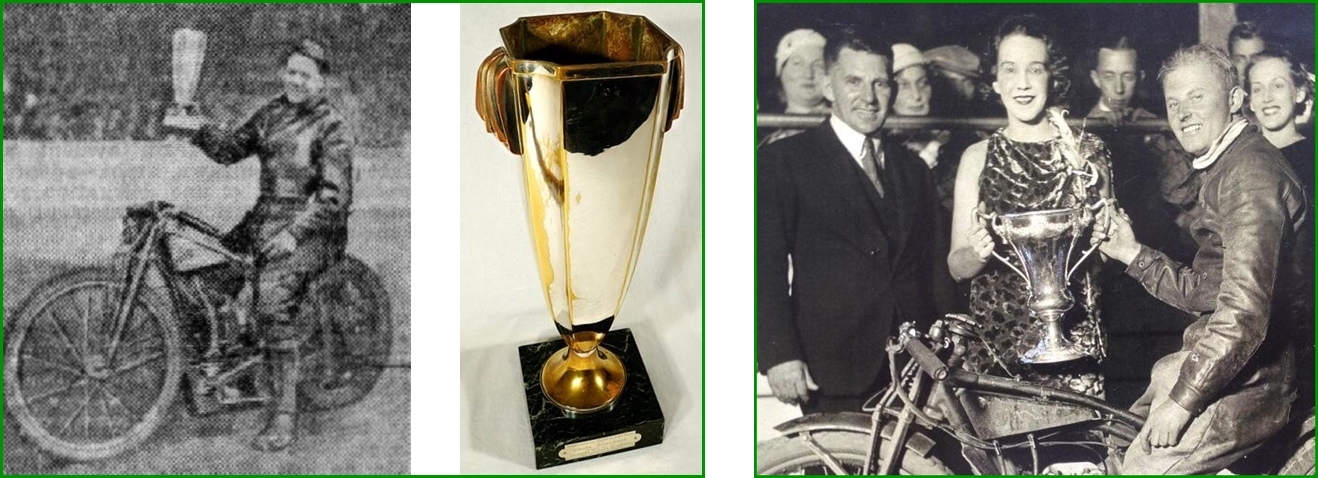
In the UK two
competitions existed which, at the time or since, have been termed or
considered as World Championships. With 2-man match races between
star riders often the highlight of any dirt-track race meeting, - the
top stars were initially excluded from league race teams - , a match
race competition for the ‘Individual World Championship’ was
initiated in 1931 by the Promoters Association, the first nominated
holder of which was Vic Huxley who beat a nominated challenger, Colin
Watson. Huxley was then challenged by Jack Parker who beat the first
champion to relieve him of the trophy and be declared Individual
World Champion. However, after the event the Speedway Control Board
refused to recognise the title: the competition subsequently became
the ‘British Individual Championship’, the pre-war forerunner of
the British Match Race Championship. Notwithstanding, Parker always
maintained his World Champion status, for he had an inscribed trophy
as proof !
The ‘Star’
Championship, held each year at Wembley other than in its inaugural
year, was launched to identify the supreme speedway rider and is
considered by many as the forerunner of the official World Final. As
the format of the Star Championship developed, from knock-out match
races through to ultimately a 16-rider 20-heat competition, it was
supplanted in 1936 by the ACU Final, having exactly the same format,
venue, calendar date, and similarly having qualifying rounds at each
1st Division track. Though each year saw a different champion it was
4 years before an Englishman was to see off the Aussie and American
stars, who were segregated in the initial year of 1929, being
considered too experienced for the English new-starts.
Full results of all 'Stars' and other early World Championships are given in the above table.
Below, World Champs' photos.